WELCOME TO HANDS IN NEPAL
Dear Supporters,
By now most of you have seen the brutal videos or photos of the catastrophic flash flood that has struck Nepal near its border with Tibet. People, villages, schools, hospitals, bridges, everything in the path of the raging water is gone and now there are threats of yet another flood.
Many of you have reached out to HANDS in Nepal, knowing of our education projects over the years and of the many Nepal friends we have made, to ask how to help.
You may help by making donations either via our PayPal account or directly to the Nepal government, or by sending a check to HANDS in Nepal. We have several trusted contacts in Nepal that we have used over the years to distribute aid funded by your donations.
I have been in direct contact via phone and email with both Kavita and Bhupendra. They have given me up to date information on what is happening in the areas of flooding. Below is the latest information and the best ways to help.
Both Kavita and Bhupendra have explained that the new government in Nepal has set up a relief fund to help flood victims. The new Prime Minister is using the army and helicopters to rescue people and get supplies where they are needed. The government has swiftly created a fund to help finance the rebuilding of homes, schools and hospitals. It’s wonderful to hear their new government is being very proactive in distributing help and aide where needed.
Unfortunately over 2,000 are missing and still thousands more are displaced and unhoused. Bhupendra is gathering supplies to transport by vehicle up to critical areas to help. We worked with Bhupendra to do a similar thing after the massive 2015 earthquake disaster. At that time, we raised money and were able to buy tin and blankets to provide temporary housing and as well as much need food supplies. Winter is coming-very quickly those mountainous regions will be bitter cold. Blankets and cooking fuel will be vital.
Kavita explained that in the upper mountainous areas where glacial lakes are, an earthquake triggered a rush of water from a glacial area. This then blocked rivers until overflowing occurred as water built up. Glacial melting is certainly a factor-there was no rain at the time.
As of today, August 28, the Nepal government is reporting that 644 trekkers are reported missing; of those, 517 are from other countries, and 127 are Nepalese. Approximately 94% of people rescued are men, and many are asking why-there are theories that women could not run as fast, or were occupied with gathering children and old people in the household. 350 people were rescued from a tunnel at a hydropower damn after army engineers cleared boulders and debris from the entrance. There are many tunnels like this, Kavita said, and there could be more victims sheltering in them but who are block by debris and cannot get out.
It is difficult to know how many people have been killed because so many ran high “up in to the hills” and are not accounted for yet. The water level in most areas was as high as 200 meters.
The scope of this tragedy has yet to be fully realized. Rescues and searches for the missing are ongoing. When talking to Kavita yesterday evening, hearing how extensive the loss and devastation is, I felt like Nepal is doomed. But this is Nepal; an ancient, strong, amazing country with the most resilient, compassionate, community-oriented people (It really does take a village!!) I’ve ever met. I know they will rise above this and show the world how it’s done. Let’s help them by supporting the relief funds
HANDS in Nepal is a 501(c)3 organization (Tax ID #27-0777768) so your donation is tax deductible. Checks, payable to HANDS in Nepal may be sent to:
HANDS in Nepal
PO Box 738
Santa Margarita, Ca. 93453
You may also donate via the PayPal if you prefer to make a donation with your credit card.
You may also donate to the Nepal Government fund here:
You may contact me at my email or text/WhatsApp me at 1-805-801-3809.
I know it’s easy to feel helpless in the face of such a huge natural disaster, but a monetary donation is something you can do NOW that really will make a difference.
Thank you for caring!
Namaste and many, many Tashi Deleks,
Jan “Didi”
I know it’s easy to feel helpless in the face of such a huge natural disaster, but a monetary donation is something you can do NOW that really will make a difference.
Thank you for caring!
Namaste and many, many Tashi Deleks,
Jan “Didi”


A New Chapter For Nepal
By HANDS in Nepal Project Manager Kavita Adhikari and HANDS Board member Jan Sprague Chaffin
Nepal recently had many days of protests in the capital city of Kathmandu as well as other cities around the country. We want to assure our patrons that HANDS in Nepal is continuing our work to support education in remote, rural areas of Nepal.
We have representation on the ground in Nepal throughout the year.
Kavita Adhikari, our Project Manager, has reported to our Board during this time of the “revolution” and explains what happened.
“Nepali people were not happy with all the political leaders because of the corrupted system,
“The government discouraged people who were working for the welfare of Nepal, instead of encouraging. For example, Kulman Ghising, a managing director of Nepal Electricity Authority since 2016 was removed from his post for no reason. A person close to the current political party replaced him. Likewise the Nepal government did not support young leaders who sought to make changes for the better such as Balen, mayor of Kathmandu Metropolitan city, Harka Sampang (Mayor of Dharam metropolitan city), Sanduk Ruit, an eye doctor and Mahabir Pun all not supported supported by the government as they sought progressive changes to better Nepal. Things were coming to a head among the public who grew more and more discontent. “
An incident involving a government leader hitting a young girl with a car and leaving the scene, sparked outrage on social medie. Postings of “nepo babies” who use social media to flaunt their extravagant lifestyles, added more fuel to the discontent of the general populace of Nepal. The Prime Minister made a decision to ban social media. That lit the candle among the young people who felt the need to express their frustration with the government, and now were cut off. Gen. Z raised their voices against the irresponsibility of the minister who had hit the girl, nepotism and “Nepo kids” (children of government officials) who were flaunting their wealth with social media posts of private schools overseas, and indulgent lifestyles, and organized a protest in Kathmandu and other cities of Nepal.
What started peaceful quickly became violent when the government tried to suppress the uprising by meeting protestors with guns and water hoses. Many became injured, 19 were shot dead the first day (death toll is now up to 52) and many are missing. Prime Minister Oli resigned and was whisked away by helicopter to an undisclosed hiding place. By the second day, more people came out on the road to protest, of every generation, defying a curfew. People in the protest were so aggressive that they targeted political leaders and their property. Many politicians were beaten by the public and many leaders' houses were burned. By 10 pm, the army tried to control the situation and a curfew was put in place by military officials.
In the days that followed, with a collapsed government, leaders of the Gen Z movement, the military chief, and other progressive leaders met to elect an interim council. Sushila Karki, an experienced and well-respected judge who has served Nepal as a Chief Justice, became the new prime minister and first women prime minister of Nepal.
A new chapter in Nepal's history has begun. Kavita says, “For the first time ever, our nation is led by a woman prime minister. This is not just a victory of position, it is a victory of generation, of voices, of truth and of change. Salute to GenZ who stood against corruption and injustice, and ignited a new hope for Nepal. Now is the time for honest politics, equality and the making of a new Nepal. This moment will be remembered for generations to come.”
All our HANDS projects remain strong. The children we help in schools in poor villages, the women we support in learning sewing skills and donations we make for safe shelters of abused girls and the street school we have helped to support-all have a new importance to keep our programs thriving as the new government shapes the future of Nepal. We have faith in the strength of the Nepalese people to set their country on a better path forward, and feel resolute in our attempts to help in the rural areas we have been working in to bring education to all.
HANDS in Nepal Newsletter 2025

On Wednesday, November 16, Chef Garrett Morris and Jan were guests on Dave Congalton's talk show on KVEC News talk radio station 96.5 FM and 920 AM. Garrett was a Peace Corps volunteer in Nepal and learned Nepal cooking from his host family. Jan will be talking about our current HANDS educational programs. Hope you brew a cup of your favorite hot beverage and listen to Garrett's amazing story!
HANDS in Nepal Summer Newsletter 2024
Helping Women and Children in Remote, Rural Areas of Nepal
How your donations help us to help those who need a hand up!
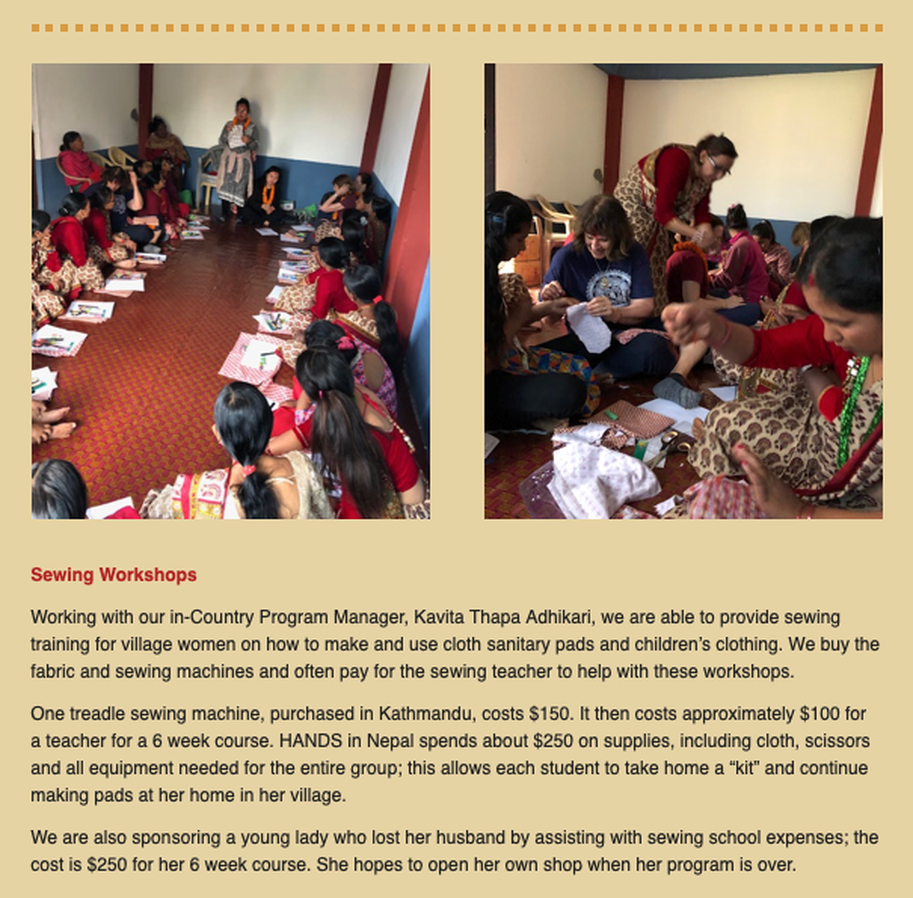
Introducing our new sewing program: “One Stitch at a Time”
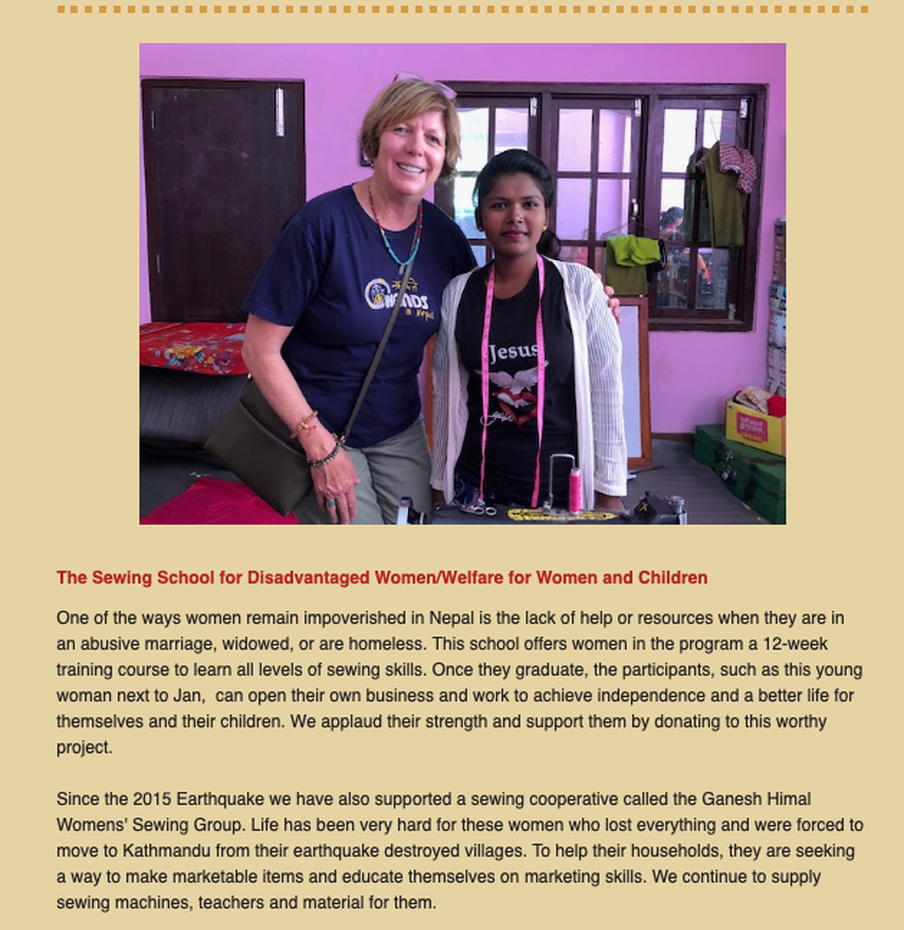
Did you ever think of how a sewing machine, and sewing education, could help a woman develop vocational skills that could support herself-and her family? For years, we’ve helped women to gain independence through sewing education. Most women in Nepal are often completely dependent on their husbands. Usually pulled from school early in their education for work at home, often married as young teenagers, women in rural areas can find themselves at a loss when their husbands decide to leave or tragically pass away too early. Women are left to support their families or sometimes are outcast. We have found supplying a woman with a sewing machine and training on how to use it gives them an opportunity to earn money through tailoring and sewing projects.
Now we are taking sewing education one step further by creating a new program called One Stitch At A Time. This program aims to go beyond learning how to use a sewing machine to being able to do advanced sewing and create job opportunities for themselves. One Stitch at a Time will provide women with the proper facilities to become self-sufficient. The program gives women a six month program in a sewing school in Pokhara, Nepal, a sewing machine that they keep after their program and an allowance that allows them to buy material and sewing supplies during their program.
We have several women who, after completing the program, are now sewing school uniforms, tailoring, and teaching others sewing skills.
It takes approximately $600 for a 6 month training to help a woman complete the first level of a sewing program. For that amount, HANDS is also able to buy and gift her a treadle sewing machine to use, plus an allowance for cloth and supplies.
To read more about the women we’ve helped, and how you can help them, please click the link below…
Free, Public Education For All? Unfortunately, Not In All Countries!
But With HANDS in Nepal “Home To School” Program, we can help!
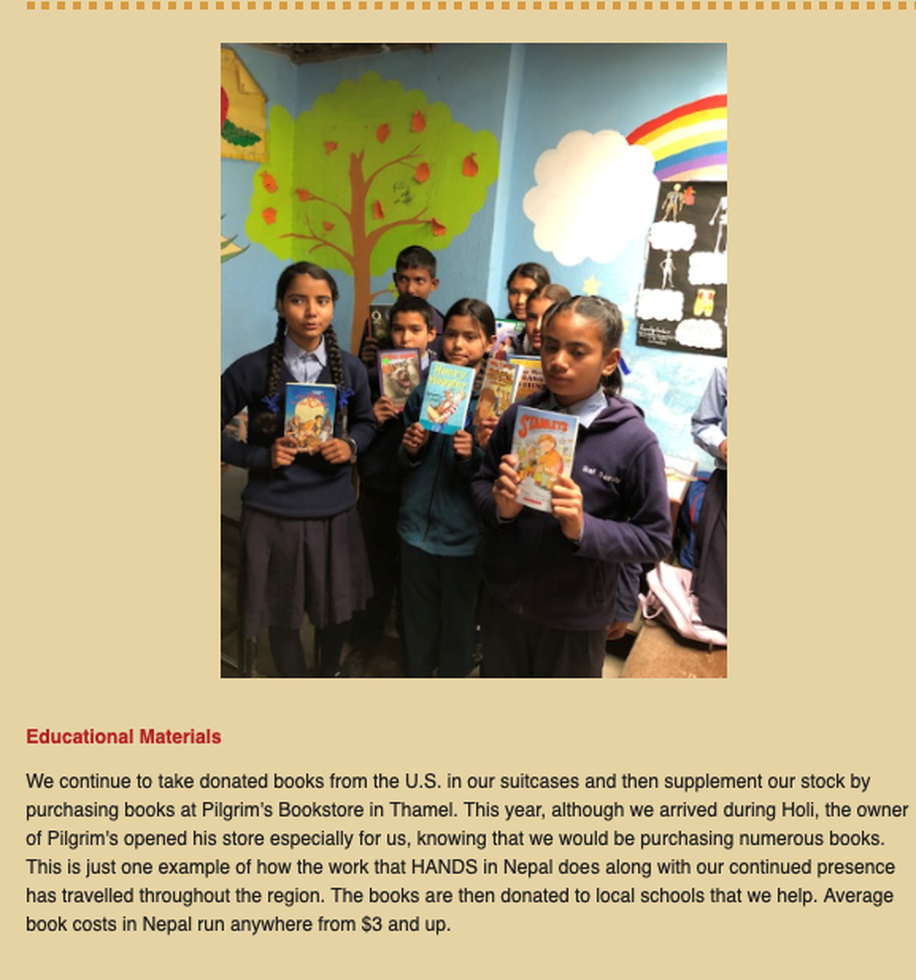
Nepal charges tuition and school material fees for all children to attend public school. Many families in Nepal cannot afford to send their children to school due to the costs. Although Nepal is one of the poorest countries in the world, their government requires all children to wear a school uniform, bring their own supplies, buy school books and provide their own “tiffin” (daily lunch). For those families living at subsistence levels, they simply cannot afford for their children to attend school. These children usually find jobs, or work at home, where, instead of attending school, they labor in the fields, work in hotels, become “errand boys” or tend livestock. Many of these kids grow up illiterate and the cycle of poverty continues.
Kavita Adhikari, our project manager in Nepal, has a solution! Home to School aims to help children of the lowest caste, and in the most impoverished families in rural villages of Nepal. Kavita has canvassed the area to interview and find children who are currently not in school due to poverty. We have managed to raise the funds to put 43 children in school this year. Our goal is to help these 43 children stay in school as long as we can raise their annual tuition and fees. These children were selected through interviews with Kavita Adhikari and run across all grade levels from primary to upper grades. With continued support from our donors, we can keep the 43 in school, and hopefully add more and more children to our scholarships list.
We have photos and a list of the children we are sponsoring, and will be tracking their progress.
Below is a breakdown of costs for each individual child attending school in Nepal.
Tuition $100
Uniform: $15
Tiffin $45
Stationary (textbooks, pens, ect) $40
In total, it costs roughly $200 a year for one student to attend public school.
If you’d like more information on anything in this newsletter, please email Jan at [email protected]
If you’d like to make a donation to our “little NGO that can”, please click here:
HANDS in Nepal is a 501 (c) 3 not for profit organization that believes all children deserve an education

CONTACT US!
Email: Jan Sprague: [email protected]
Kevin O'Shea: [email protected]
Write us at: HANDS in Nepal, PO Box 738, Santa Margarita, Ca. 93453
UPS or FedEx: 22595 I. Street, Santa Margarita, Ca. 93453
Call us at: 805-801-3809 or 805-423-0120
HANDS in Nepal is a registered 501(c)3 NGO.
Our Tax ID # is 27-0777768.
